


Views: 0 Author: Site Editor Publish Time: 2026-09-02 Origin: Site


Have you ever tried tightening a nut on a long threaded rod? You likely felt your tool abruptly stop before the job was done. Standard hand tools quickly bottom out when faced with extended hardware. This inherent design flaw leaves the fastener loose. It compromises the structural integrity of your assembly. More importantly, it causes unnecessary frustration on the job site.
As engineers frequently discover, standard tools fail when confronted with extended hardware. Let us examine exactly how a pass-through design resolves these physical barriers. We will detail why specific metallurgical choices matter and how ergonomic grips reduce daily fatigue. Furthermore, we will establish clear criteria for selecting the perfect tool to conquer deep-recessed hardware.
Purpose-Built Design: A hollow shaft allows long threaded rods and bolts to pass entirely through the tool core, making it an absolute necessity for deep fasteners.
Material Matters: Premium configurations utilize an S2 steel shaft for unmatched durability and high-torque resistance. This material far outperforms standard CR-V steel.
Ergonomic Comfort: A specialized thickened TPE handle provides a non-slip, anti-fatigue grip. This tactile feedback is crucial for repetitive industrial tasks and oily environments.
Enhanced Efficiency: Integrating a magnetic retention ring within a hollow shaft prevents dropped fasteners in blind spots and vertical channels.
Versatile Applications: This tool is indispensable for HVAC installations, electrical panel assemblies, appliance repair, and modern automotive work where standard ratchets simply cannot fit.
While the name implies it drives traditional screws, this tool actually functions as a highly specialized nut driver. It is engineered with a hollowed-out center core extending from the female hex socket tip deep into the metal shaft. In professional-grade models, this hollow channel passes entirely through the handle itself.
The mechanics behind it are straightforward yet incredibly effective. When you use this tool to drive a nut down a long threaded bolt, the excess length of the bolt passes harmlessly up into the hollow core. Consequently, the socket maintains continuous, flush contact with the nut. This holds true regardless of how far down the threaded rod the hardware needs to travel.
The primary limitation of a standard solid-shaft nut driver is its finite internal depth. Once the threaded rod hits the solid back wall of the socket, the tool is physically pushed off the nut. At this critical point, the user can no longer apply torque. Upgrading to a dedicated deep fastener screwdriver bypasses this physical barrier entirely. It allows for uninterrupted rotation and significantly faster assembly times.
To illustrate the operational differences, consider the following technical comparison:
Feature | Standard Solid-Shaft Nut Driver | Hollow Shaft Screwdriver |
|---|---|---|
Internal Clearance | Limited strictly to the depth of the socket, typically 0.5 to 1 inch. | Extends deep into the shaft, often exceeding 3 inches or featuring a full pass-through. |
Threaded Rod Compatibility | Fails immediately on long bolts and stacked nuts. | Excels on long studs and deep-recessed threaded rods. |
Primary Use Case | Flush nuts, standard hex-head screws, and short bolts. | HVAC mounts, electrical panels, and deep automotive studs. |
Transitioning to a hollow shaft design is a practical necessity for tradespeople who regularly encounter varying fastener depths. It effectively eliminates the need to constantly switch tools mid-task, thereby streamlining your entire workflow.
Professionals and DIYers alike frequently encounter situations where standard fastening tools prove completely inadequate. Understanding the mechanical failures of these standard tools highlights exactly why specialized equipment is required on the modern job site.
Pain Point 1: Bottoming Out
The most frequent issue occurs when mounting hardware to long studs. Imagine securing a heavy television wall bracket or replacing an automotive alternator. A standard socket will engage the nut initially. However, as the nut travels down the thread, the rod protrudes further into the socket. Once the rod hits the back of the socket, the tool loses its grip. This frustrating phenomenon is known as bottoming out. The user is forced to stop, leaving the fastener loose and the structural assembly compromised.
Pain Point 2: Clearance Issues with Ratchets
A common question raised in mechanical forums is why mechanics do not just use a deep socket and a ratchet. While ratchets are undeniably excellent for high-torque applications, they demand significant lateral clearance. The head of a ratchet is bulky. Its swinging motion requires a wide radius to operate. In tight, recessed spaces, such as inside a washing machine chassis or a crowded electrical junction box, a ratchet simply cannot fit. A screwdriver-style handle operates on a straight, narrow axis. This allows it to reach into deep channels where bulky ratchets fail.
Pain Point 3: Stripped Threads and Wasted Time
When standard tools fail, frustrated users often resort to improvising with inappropriate alternatives. Forcing needle-nose pliers or adjustable wrenches into tight spaces frequently leads to rounded nut edges. It causes stripped threads and severely damaged hardware. Furthermore, struggling with the wrong tool drastically slows down productivity. A routine five-minute maintenance task quickly turns into a prolonged ordeal.
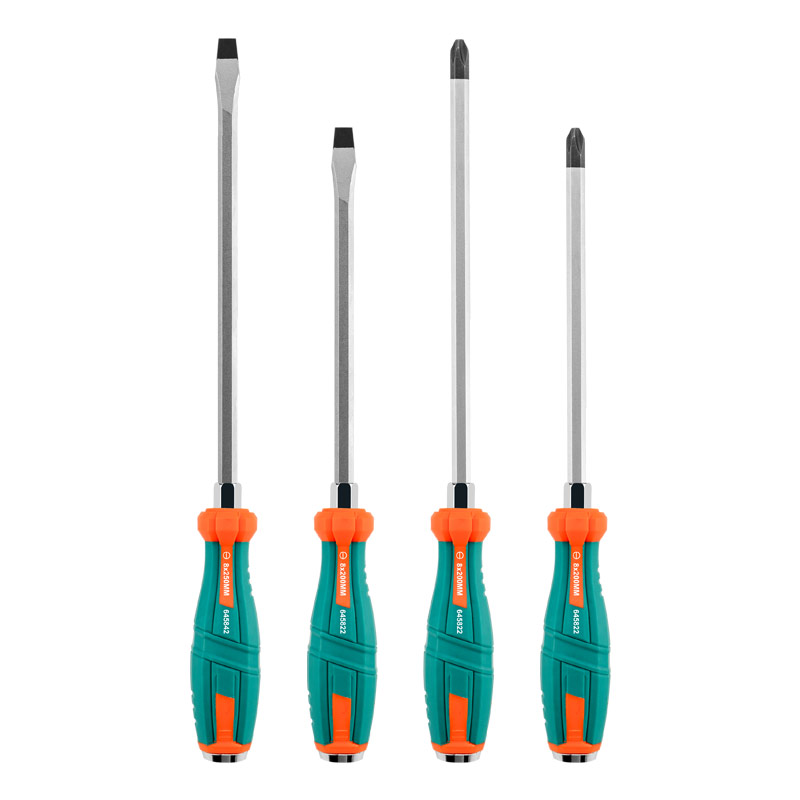
Not all hollow shaft tools are manufactured to the same rigorous standards. For demanding industrial applications, the metallurgical composition, handle ergonomics, and tip functionality play critical roles. These factors directly determine the tool longevity and daily performance.
The material forged into the shaft dictates the tool ability to withstand rotational torque without deforming. Standard consumer-grade tools are typically stamped from Carbon Steel or basic Chrome Vanadium steel. While Chrome Vanadium is adequate for light-duty household tasks, it can warp or round out under high-stress industrial applications.
Premium hand tools utilize an S2 steel screwdriver shaft. S2 steel is a complex, shock-resisting tool steel alloyed with silicon, molybdenum, and vanadium. It is properly heat-treated to achieve a hardness rating of HRC 58-62. This registers significantly higher on the Rockwell Hardness Scale than standard alloys. This superior hardness guarantees that the internal hex socket maintains its precise geometric shape over years of heavy use. When applying high torque to a stubborn, rusted nut, an S2 steel shaft will resist shattering and prevent the socket from rounding off.
Industrial environments demand tools that can be utilized continuously without causing user fatigue. This is where the engineering of the handle material becomes crucial. Thermoplastic Elastomer is an advanced hybrid material. It perfectly combines the rigid durability of plastic with the flexible, tactile grip of rubber.
Choosing a TPE screwdriver offers several objective workplace benefits. Specifically, a thickened TPE rubber-coated handle provides a high-friction surface. This allows a mechanic with greasy hands to transfer maximum torque to the fastener without slipping. Additionally, TPE is highly resistant to chemical degradation from common shop fluids, including motor oil, brake fluid, and industrial solvents. Finally, the slight ergonomic yield of the TPE grip absorbs micro-vibrations. It reduces pressure points on the palm, significantly mitigating hand fatigue during long shifts.
Working with deep fasteners inherently means operating in blind spots or vertical orientations where gravity works against you. A standard hollow shaft tool will successfully turn the nut. However, once that nut is unthreaded, it can easily fall into the machinery. This leads to lost hardware and potential mechanical damage.
To solve this critical issue, professional models integrate a magnetic screwdriver feature. Because the shaft must remain hollow, the magnet is intelligently designed as a powerful rare-earth magnetic ring seated at the very base of the hex socket. This configuration allows the threaded rod to pass freely through the center of the ring while the magnet securely holds the nut in place. It is an indispensable feature for retrieving hardware from deep, dark recesses.
The unique geometry of the hollow shaft makes it a mandatory addition to toolkits across several highly technical trades. Beyond basic repairs, specific industries rely heavily on this pass-through design to maintain efficiency.
Looking at recent industry shifts, the demand for specialized clearance tools has surged dramatically. The rapid expansion of electric vehicle manufacturing and high-efficiency smart HVAC systems dictates new engineering rules. Modern automotive and climate control engineering favors compact, densely packed assemblies to save space and weight. Consequently, technicians are finding that traditional bulky ratchets no longer fit into these miniaturized chassis designs. This trend has elevated the hollow shaft design from a niche specialty item to an absolute necessity for modern mechanical diagnostics and assembly.
Electrical Work: Electricians frequently deal with long, threaded mounting screws when assembling breaker panels, installing conduit hangers, or mounting heavy industrial lighting fixtures. The hollow shaft allows them to drive nuts down long threads rapidly without constantly switching to an awkward wrench.
HVAC Systems: Heating, ventilation, and air conditioning technicians routinely work in cramped environments. Reaching deep into ductwork to secure air handler units, or mounting thermostats on long wall anchors, requires a tool that offers both extended reach and depth accommodation.
Automotive & Mechanics: Modern engine bays are densely packed. Mechanics regularly encounter long studs holding down valve covers, battery terminals, and dashboard assemblies. A hollow shaft tool easily navigates through cluttered wiring harnesses and hoses to reach these recessed studs.
Appliance Repair: Modern appliances, such as washing machines and commercial refrigerators, utilize recessed nuts for leveling legs and internal motor mounts. These fasteners are often situated at the end of long threaded rods, requiring a deep-clearance tool for precise adjustment.
Selecting the right fastening tool depends entirely on the specific mechanical variables of the task at hand. You must evaluate torque requirements, spatial clearance, and fastener depth.
This tool is ideal for the fast assembly of standard, short-thread nuts. It is lightweight, highly portable, and quick to use. However, its utility drops to zero the exact moment the bolt thread exceeds the internal depth of the socket.
This is the optimal choice for extremely high-torque applications. Breaking loose a seized suspension bolt on a vehicle requires the unmatched leverage provided by a long ratchet handle. Conversely, it is heavy, slow for threading long distances, and requires a wide, open radius to swing the handle back and forth.
This specialized driver serves as the perfect middle ground. It offers the rapid rotational speed and tight-clearance access of a standard screwdriver. This is seamlessly combined with the depth accommodation of a pass-through socket system. While it cannot generate the extreme torque of a heavy-duty ratchet, it remains the most efficient tool for assembling and disassembling long-threaded hardware in confined spaces.
Investing in hand tools requires careful consideration of sizing, visual identification, and overall manufacturing quality. For facility managers and tradespeople, purchasing a reliable industrial screwdriver set is a calculation of long-term durability versus upfront cost. You need tools that perform under pressure.
Industrial hardware utilizes both Imperial SAE and Metric measurements. Attempting to use a close alternative, such as forcing a 1/2-inch driver onto a 13mm nut, will inevitably round off the fastener corners. Professionals must equip themselves with comprehensive sets in both measurement systems to handle the diverse machinery they encounter daily.
Time is a critical metric in professional environments. Searching through a dark tool bag for a specific size wastes valuable labor time. Industry-standard tools utilize color-coded handles, such as red for 1/4-inch, yellow for 5/16-inch, and blue for 3/8-inch. This visual management system allows technicians to instantly identify and grab the correct size without needing to squint at micro-engraved numbers on the steel shaft.
The precision of the hex socket and the metallurgical integrity of the shaft are determined by the manufacturer quality control processes. Poorly machined sockets will slip, and inferior steel will warp. Reliable manufacturers guarantee strict dimensional tolerances and proper heat-treatment processes. Look for chrome-plated finishes that ensure the tool performs reliably and resists rust under harsh industrial conditions.
Even tools forged from premium S2 steel and high-grade TPE require basic maintenance to ensure a long service life. Implementing a simple care routine prevents degradation and maintains optimal performance on the job.
The defining feature of this tool is its open core. However, this open core can easily become a trap for debris. Over time, dirt, grease, and metal shavings can accumulate deep inside the shaft. If debris builds up, it will block the threaded rod from passing through. Periodically use compressed air or a stiff pipe cleaner dipped in degreaser to dislodge any blockages from the hollow center.
While S2 steel is exceptionally hard, its higher carbon content means it is not entirely impervious to oxidation. This is especially true if the protective chrome coating is scratched. In humid environments or after exposure to moisture, wipe the metal shaft down with a light coat of machine oil or a standard water-displacing spray. This creates a microscopic barrier that stops surface rust from forming.
If you utilize a magnetic model, be aware that the rare-earth magnet will inevitably attract stray iron filings and metal dust from the workbench. A buildup of metal dust inside the socket will prevent the nut from seating fully, leading to dangerous slippage. Use a piece of strong adhesive tape or a blast of compressed air to pull iron filings away from the magnetic ring. This ensures a clean, strong grip on your fasteners.
Standard hand tools consistently fall short when working with long threaded rods and deep-recessed nuts. This physical limitation wastes your valuable time, leads to improvised fixes, and frequently damages hardware. A hollow shaft screwdriver elegantly solves this problem by allowing excess bolt threading to pass harmlessly through the handle.
When upgrading your kit, always prioritize S2 steel for exceptional torque resistance. Ensure the tool features an ergonomic thickened TPE grip to reduce hand fatigue during long shifts. By investing in the right purpose-built tool, you will significantly improve your daily workflow, protect your hardware, and tackle deep fastening tasks with ease. For professionals ready to upgrade their toolkits, selecting purpose-built equipment is paramount. Explore a comprehensive range of premium fastening solutions at Hanbon Tools to find the exact configuration your daily operations demand.
No. While it shares the handle shape and rotational mechanics of a standard screwdriver, it is specifically engineered with a female hex socket to drive nuts and hex-head bolts. It does not feature a flathead, Phillips, or Torx tip. For standard screws, you must use a dedicated screw-driving tool.
Chrome Vanadium is a cost-effective steel used in many consumer tools, offering a good balance between hardness and flexibility. S2 steel, however, is a specialized shock-resisting tool steel with higher carbon and silicon content. It achieves a higher Rockwell hardness rating. This means the edges of an S2 hex socket are significantly less likely to round off, deform, or shatter under heavy industrial torque.
No, magnetic retention is typically a premium feature. Standard models rely purely on friction and the exact dimensional fit of the hex socket to hold the nut. If you frequently work in vertical shafts, deep engine bays, or blind HVAC ducts, it is highly recommended to verify that the tool utilizes a magnetic ring design before purchasing.
This depends entirely on the specific design provided by the manufacturer. Partial hollow drivers may only offer 2 to 3 inches of hollow depth before the shaft becomes solid steel. Full hollow or pass-through designs feature a tubular steel shaft that extends entirely through the handle. This allows a threaded rod of theoretically infinite length to pass through, provided the rod diameter is smaller than the internal diameter of the shaft.
You can only do this if the tool is explicitly rated as an insulated tool, typically VDE certified to 1000V. Standard hollow shaft tools with basic TPE handles are not designed to protect against electrical shock. Because the steel shaft runs deep into the handle, a live current could easily arc to the user hand. Always use certified insulated tools for live electrical work.
If a deformed nut becomes wedged tightly inside the hex socket, do not strike the handle with a hammer. This blunt force can shatter the TPE grip. Instead, insert a thin steel punch or a solid steel rod into the back end of the hollow shaft, assuming a full pass-through design. Gently tap the punch with a mallet to push the stuck nut out from the inside.
No. These tools are designed specifically for manual torque application. The handles and internal shaft structures are not engineered to absorb the violent rotational strikes generated by a power impact driver. Using them in a power tool adapter can shatter the socket or destroy the handle. Always use dedicated impact-rated deep sockets for power tools.
If the nut is located deep within a channel where calipers cannot reach, you can use a sizing method with a piece of soft clay or putty on the end of a stick. Press the putty against the nut to get an impression, then measure the flat-to-flat distance of the hexagon impression with calipers. This measurement dictates whether you need a specific metric or SAE hollow shaft driver.


