


Views: 0 Author: Site Editor Publish Time: 2026-09-25 Origin: Site


Every mechanic or dedicated DIY enthusiast eventually faces a familiar, knuckle-busting scenario. You are under the chassis, grease coating your hands, wrestling a stubbornly rusted suspension bolt that simply refuses to budge. In these critical, high-friction moments, the quality of your equipment dictates the outcome. Have you ever snapped a cheap spanner? It is not just frustrating; it is a serious safety hazard. Using substandard tools often leads to bent handles, stripped fastener heads, or physical injury due to sudden slippage under load.
Conversely, having a reliable, dimensionally accurate hand tool transforms a frustrating extraction into a manageable, controlled procedure. This comprehensive guide strips away the marketing fluff to provide an objective, engineering-focused analysis of wrench metallurgy. Specifically, we will examine Chrome Vanadium (CR-V) steel alongside the mechanics of precision jaw fit and torque application.
By applying this technical knowledge, you can make informed procurement decisions that prevent fastener damage, save valuable shop time, and ensure long-term operational efficiency in your workspace.
CR-V Steel is Non-Negotiable: Chrome Vanadium (CR-V) provides the optimal metallurgical balance of tensile strength, structural durability, and corrosion resistance required for heavy-duty environments.
Precision Jaw Fit Prevents Damage: A strictly machined open end eliminates excessive clearance, preventing the catastrophic rounding of bolt heads under heavy loads.
Torque and Leverage Mechanics: The physical length of the handle and the specific box-end broaching (6-point versus 12-point) directly dictate how much torque can be safely applied.
Long-Term Investment: Selecting drop-forged, dimensionally accurate repair gear reduces replacement costs and minimizes the risk of damaging expensive machinery components.
Before diving into metallurgical specifications and torque ratings, we must first establish a clear understanding of the instrument's anatomy. Designed to offer both speed and raw mechanical power within a single, solid piece of metal, this tool bridges the gap between different mechanical needs without forcing you to constantly switch out your gear.
The defining characteristic of this tool is its hybrid structure. One end features a U-shaped open profile, while the opposite end boasts a closed loop, known as the box end. Both ends are manufactured to fit the exact same size of nut or bolt, providing versatile attack angles for any given fastener.
Specifically, the open end is engineered for speed and side accessibility. It allows the user to slide the jaws onto a fastener horizontally. This is an absolute necessity when working in confined spaces—like behind an alternator—where dropping a socket over the top of a bolt is physically impossible. In contrast, the box end is designed for breaking loose tough, seized fasteners. Because the closed loop completely surrounds the hardware, it distributes the applied force evenly across all contact points, significantly reducing the risk of slipping off under high pressure.
In professional bays and serious DIY garages, this dual-purpose design makes a reliable mechanic spanner indispensable across multiple trades.
Automotive Repair: Technicians rely on these for engine block disassembly, brake caliper removal, and serpentine belt adjustments, where space is notoriously tight and torque requirements are high.
Plumbing and Pipefitting: Securing heavy-duty valves and tightening flange bolts often requires the side-access capability of the open end.
Heavy Machinery Maintenance: Industrial equipment demands implements that can withstand continuous, repetitive stress without structural deformation.
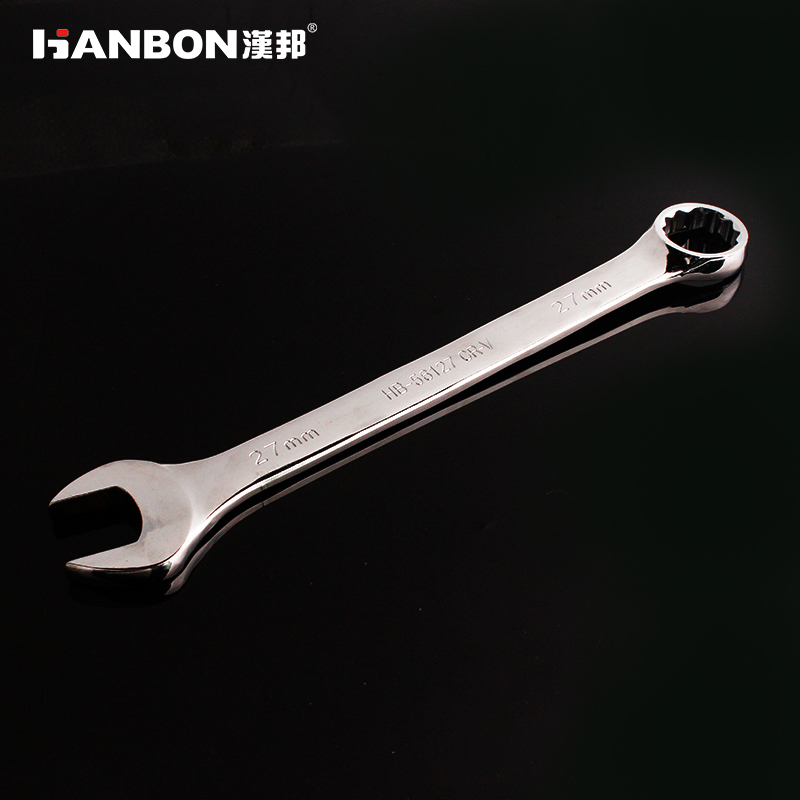
When evaluating hand tools, the material composition is the single most critical factor determining longevity. For professional-grade applications, Chrome Vanadium steel has become the undisputed industry standard, vastly outperforming basic carbon steel alternatives.
CR-V steel is an advanced alloy combining carbon steel with specific percentages of chromium and vanadium. Each element serves a distinct, vital metallurgical purpose. The addition of vanadium acts as a refining agent during the forging process. It creates a finer grain structure within the steel, which translates to superior toughness and fatigue resistance. Rather than snapping under sudden, heavy loads, the metal can flex slightly and absorb extreme pressure without permanently deforming.
Furthermore, chromium significantly enhances the metal's hardenability. A professional CR-V wrench is typically heat-treated to an optimal hardness of HRC 42-48. This specific range allows the tool to withstand high-friction environments while keeping the jaw edges sharp over decades of use. Carbon steel tools, by comparison, are prone to brittleness if over-hardened, or rapid rounding if left too soft.
Material Feature | Standard Carbon Steel | Drop-Forged CR-V Steel |
|---|---|---|
Tensile Strength | Moderate to Low (Prone to bending) | High (Resists deformation under heavy loads) |
Hardness (HRC) | Inconsistent (Often below HRC 40) | Optimized (HRC 42-48 for edge retention) |
Corrosion Resistance | Poor (Requires constant oiling) | Excellent (Forms passive oxide layer) |
A workshop is a hostile environment for bare metal. Equipment is routinely exposed to moisture, acidic battery fluids, synthetic motor oils, and corrosive degreasers. Fortunately, the chromium content in CR-V steel forms a microscopic, passive oxide layer on the surface. Even if the outer mirror-polished chrome plating is slightly scratched during a heavy pull, the underlying alloy resists aggressive rusting, ensuring structural integrity remains intact.
Recent market analyses regarding hardware procurement reveal a distinct shift in consumer and professional buying habits. Modern automotive engine bays are becoming increasingly compact, particularly with the rise of hybrid and electric vehicles (EVs). Simultaneously, industrial machinery utilizes fasteners with much higher torque specifications than in previous decades.
Consequently, the demand for slim-profile tools featuring anti-slip geometries and extended leverage points has surged. The industry is trending heavily toward equipment that prioritizes fastener preservation and user ergonomics over sheer budget pricing. Technicians and procurement managers now acknowledge a simple truth: a stripped bolt on an assembly line costs far more in labor and downtime than a premium, high-tolerance tool costs to purchase.
While strong steel prevents the tool from breaking, precision machining prevents the fastener from breaking. Tight manufacturing tolerances are critical. A fraction of a millimeter in excess clearance can lead to immediate hardware failure.
"Rounding" occurs when the edges of a hexagonal nut or bolt are stripped away, turning the hex shape into a circle and making it nearly impossible to remove. Excessive jaw clearance is the primary culprit behind this failure. When manufactured with loose tolerances, the tool does not sit flush against the hardware.
Instead of applying rotational force evenly, the loose wrench shifts. It applies concentrated, shearing pressure directly to the sharp, fragile corners of the bolt. Under high torque, the metal of the bolt yields before it turns. A precision-machined automotive repair wrench slides onto the fastener snugly, with zero perceptible "play" or wiggling, ensuring force is distributed safely across the fastener's mass.
To further mitigate fastener damage, modern high-quality designs employ an engineering concept often referred to as "flank drive." Traditional designs applied pressure directly to the 60-degree corners of a hex bolt. Advanced designs, however, feature slight reliefs or convex curves in the broaching of the box end.
This structural modification forces the tool to grip the flat sides (the flanks) of the fastener rather than the delicate corners. Because the flat sides have significantly more surface area, you can apply substantially more torque without the risk of slipping. This feature is an absolute necessity when dealing with rusted exhaust bolts or over-tightened suspension components.
Applying force effectively requires an understanding of basic physics. In the context of mechanical work, torque is the rotational force applied to a fastener, governed by the length of the tool and the design of its contact points.
The principle of leverage dictates that torque equals force multiplied by distance. Consequently, the physical length of the handle directly impacts how much physical effort is required to turn a bolt. Standard-pattern designs offer a balanced length suitable for most daily tasks, remaining compact enough to maneuver inside tight spaces. Long-pattern designs feature extended handles. The increased distance from the fastener allows the user to generate massive torque with minimal physical strain.
A word of caution for field mechanics: using "cheater bars"—slipping a hollow metal pipe over a standard handle to increase leverage—is highly discouraged. It immediately exceeds the engineered stress limits of the metal, risking sudden snapping of the steel or immediate crushing of the fastener.
The internal broaching of an open box end wrench determines how it interfaces with the fastener. Buyers must choose between 6-point and 12-point configurations based on their specific operational needs.
For sheer breaking power on stubborn, heavily rusted bolts, a 6-point design is superior because it provides maximum surface contact with the fastener flats. In contrast, a 12-point design allows the user to seat the tool onto the bolt at 12 different indexing angles. This offers a tight 30-degree swing arc, making it much easier to use in cramped areas where handle swing is severely limited, though it is slightly more prone to slipping on severely degraded hardware.
Beyond metallurgy and torque capacities, several physical characteristics dictate how a tool performs in daily, practical scenarios. Evaluating these secondary features ensures the equipment aligns with your specific workflow.
The exterior finish serves a highly functional purpose. Fully polished, mirror-chrome finishes are highly reflective and smooth, making them incredibly easy to wipe clean of grease and oil with a simple shop rag. However, they can become slippery. A matte or satin finish provides a slightly textured surface. When a mechanic's hands are slick with transmission fluid, a satin finish offers a superior, tactile grip.
If you lay a standard flat spanner on a table, you will notice the box end is typically not flush with the handle. High-quality models feature a standard 15-degree offset angle. This slight upward bend lifts the handle away from the working surface. This clearance is vital for protecting the user's knuckles from painful scrapes against engine blocks while allowing for a full, unobstructed range of motion.
Selecting the correct measurement system is a foundational step. Using an implement that is merely "close enough" in size (like using a 1/2-inch on a 13mm bolt) is the leading cause of stripped hardware.
The global manufacturing industry has largely standardized around the Metric system (millimeters). Almost all modern vehicles utilize metric fasteners. Sizes ranging from 8mm to 19mm will cover the vast majority of standard automotive repairs, while heavy machinery often requires sizes up to 32mm. SAE (Society of Automotive Engineers) sizes, measured in fractions of an inch, are still heavily prevalent in classic machinery, aviation, and legacy industrial equipment.
High-quality tools are an investment. Implementing a strict maintenance protocol ensures that the precision jaw fit and structural integrity endure for generations.
Despite the rust-resistant properties of chromium, equipment should never be put away wet or covered in corrosive chemicals. At the end of a workday, wipe each piece down. For heavily soiled items, a quick spray of a light machine oil serves a dual purpose: it acts as a solvent to break down stubborn grease and leaves a microscopic protective film over the metal to repel ambient humidity.
Tossing loose metal into a drawer is detrimental. As heavy steel clashes together, the precision-machined edges can become dented or burred, destroying the tight tolerances. Optimal storage solutions for workshop hand tools include custom-cut EVA foam trays or heavy-duty canvas rolls, which prevent any metal-on-metal contact.
Finding a manufacturer that consistently meets strict metallurgical and machining standards is critical. The market is flooded with substandard alternatives that compromise on steel quality to lower production costs.
When sourcing reliable equipment, professionals look for brands that prioritize high-grade, drop-forged Chrome Vanadium steel and rigorous quality control. Hanbon Tools utilizes strict heat treatment processes to achieve that optimal HRC 42-48 hardness, while their precision machining guarantees the tight jaw fit necessary to protect fasteners. Investing in a manufacturer with a proven track record of structural integrity and ergonomic design is the most logical decision for any serious technician.
Upgrading your workshop arsenal is not just about buying shiny new metal; it is about investing in efficiency, precision, and safety. Always insist on drop-forged CR-V steel for maximum durability and rust resistance. Pay close attention to precision jaw fit to prevent costly fastener damage, and select the correct handle lengths and box-end points based on your specific torque requirements. Good tools make difficult tasks manageable, turning frustrating repairs into satisfying projects. Take inventory of your current toolbox today, identify the missing or degraded sizes, and upgrade to reliable sets that will last a lifetime. Explore professional-grade solutions at Hanbon Tools to ensure your next project is backed by uncompromised quality.
A combination wrench specifically features an open-end U-shape on one side and a closed box-end ring on the other. Both ends are machined to fit the exact same size fastener, providing the user with both speed for tight spaces and high-torque capabilities for stubborn bolts in one single tool.
CR-V stands for Chrome Vanadium. It is a highly durable steel alloy. Chromium is added for superior rust resistance and surface hardness, while vanadium is added to increase the metal's tensile strength and toughness, allowing it to flex slightly under extreme pressure without snapping.
No. Using a hollow metal pipe (commonly called a "cheater bar") over a handle applies torque forces that far exceed the tool's metallurgical design limits. This dangerous practice will likely snap the steel or permanently crush the fastener. Instead, use a longer wrench or a dedicated breaker bar.
A 6-point box end is better for applying heavy torque to stubborn or rusted bolts because it maximizes surface contact with the flat sides of the fastener. A 12-point box end is better for working in tight, restricted spaces because it allows you to seat the tool at twice as many angles, requiring less handle swing.
For modern automotive repair, metric sizes are the absolute standard. A set ranging from 8mm to 19mm is essential, with 10mm, 12mm, 13mm, 15mm, and 17mm being the most frequently used sizes for engine components, brakes, and suspension systems.
While exact torque limits depend on the size of the wrench and the quality of the steel, a high-quality CR-V wrench is engineered to withstand torque well beyond the failure point of the corresponding standard bolt. For example, a quality 19mm wrench can safely handle upwards of 150-200 ft-lbs of torque, provided the force is applied smoothly without impact.
A tool with precise jaw fit will slide onto the corresponding fastener snugly with virtually zero rotational "play" or wiggling. This tight dimensional tolerance ensures the rotational force is applied evenly to the sturdy flats of the bolt, preventing the fragile corners from rounding off.


