


Views: 0 Author: Site Editor Publish Time: 2026-09-16 Origin: Site


In the fast-paced world of professional auto repair, time translates directly into revenue. Wasting seconds rummaging through a cluttered cart for the correct size cuts into a technician's flat-rate efficiency. Mechanics frequently encounter fasteners of varying dimensions clustered within inches of one another. Consequently, the simple act of switching tools transforms into a frustrating operational bottleneck.
The practical solution to this common dilemma is the dual-size wrench design. Offering two consecutive sizes on a single handle eliminates wasted motion entirely. In this comprehensive technical guide, we will explore how this specific design reclaims lost minutes on the shop floor. We will examine its most critical automotive applications and discuss why precise metallurgy is non-negotiable when outfitting a modern garage.
Instant Adaptability: Featuring two complementary sizes such as 10mm and 12mm, this tool allows technicians to seamlessly flip the handle. This drastic reduction in tool-fetching streamlines the entire repair process.
Tight Space Mastery: The open-end profile slides onto fasteners laterally. This side-access capability is indispensable for inline fittings like brake lines and fuel filters where standard closed sockets physically cannot fit.
Space and Weight Reduction: Carrying a dual-size set effectively halves the total number of individual tools required. This minimizes clutter in a mobile mechanic bag or a stationary tool cart.
Material Durability: For commercial applications, selecting a high-quality alloy ensures the tool withstands high torque without bending or rounding off delicate hardware.
To make informed procurement decisions, workshop managers and frontline engineers must understand exact tool specifications. Recognizing these subtle design differences prevents costly hardware damage during complex assemblies.
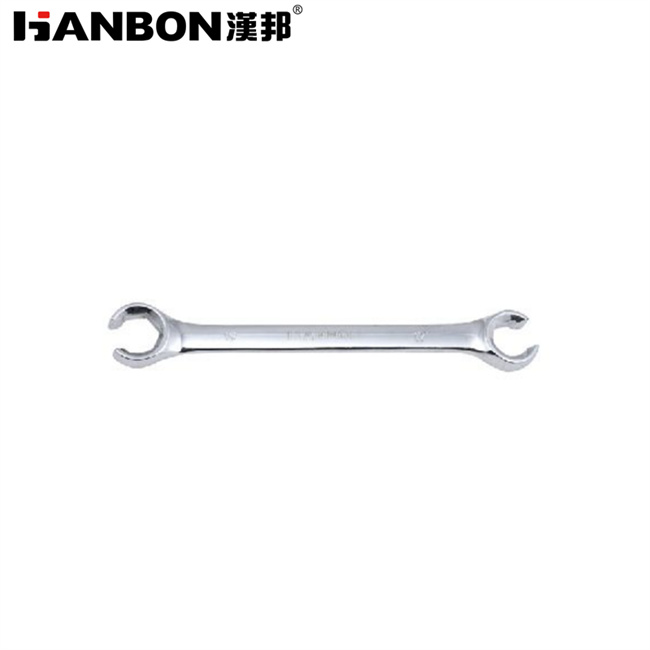
At its core, this specialized hand tool features a flat metal handle with a U-shaped opening at both ends. Unlike traditional single-size equipment, this design incorporates two different sizes on the same piece of metal. Common metric pairings include 10mm and 12mm, or 13mm and 15mm. Within standard SAE measurements, combinations like 1/2 inch and 9/16 inch are standard.
The jaws are typically machined at a 15-degree angle relative to the handle axis. This precise offset allows the user to flip the wrench over to engage the fastener from a completely different angle. When hands are covered in grease deep inside a confined engine bay with a limited swing arc, this angled flip provides a massive mechanical advantage. Unlike a standard combination tool, a premium double ended wrench actively reduces the total number of items a mechanic needs to bring to the vehicle.
Recent industry shifts toward hybrid and electric vehicles have drastically reduced engine bay clearances. As vehicle architectures become denser, technicians are actively abandoning bulky, single-purpose equipment. Current automotive maintenance trends heavily favor multi-functional, slim-profile gear. This lean operational approach minimizes fetch time, directly boosting daily throughput.
During complex assemblies, mechanics encounter multiple fastener sizes within a tight radius. Consider adjusting a steering component. A technician might need to hold a bolt head steady with a 13mm tool while simultaneously tightening the locking nut with a 15mm tool. Relying on single-size tools forces the technician to locate, pick up, and awkwardly switch between separate items.
By utilizing a dual-size mechanic wrench, the workflow transforms into a fluid motion. Flipping the tool takes roughly one second. Walking back to a tool chest easily consumes thirty seconds. Over a busy week, these saved seconds compound into hours of reclaimed labor time. Furthermore, a less cluttered cart means faster visual identification of the required size, reducing cognitive fatigue during long shifts.
Empirical data from commercial workshops demonstrates that specific automotive systems rely heavily on side-access tools. These open-end profiles excel in scenarios where closed-loop sockets are mechanically impossible to deploy.
Hydraulic brake systems utilize rigid steel tubing and flexible rubber hoses. A closed box end forms a continuous circle, meaning it cannot slide over a long brake line to reach the fitting nut. The open-end design is mandatory here, sliding onto the hex nut laterally. Having two sizes on one handle proves particularly useful when bleeding brakes, as bleeder valves and line fittings often feature slightly different metric dimensions.
Steering and suspension alignments require precise micro-adjustments of tie rods. Mechanics must loosen a jam nut, rotate the inner tie rod to correct the toe angle, and tightly secure the nut again. These components sit deep within the dark wheel well with minimal clearance. The slim profile of a dual-size tool allows technicians to reach these jam nuts without dismantling surrounding suspension components.
Modern fuel systems utilize delicate aluminum or brass inline fittings. These softer metals are highly prone to rounding off if improper tool geometry is applied. Since sockets cannot pass over continuous fuel lines, a precision-machined open end provides the necessary side-access to carefully apply torque. This ensures pressurized lines are safely disconnected without causing leak-inducing damage.
Mechanics frequently debate the exact utility of different wrench profiles. Understanding the mechanical advantages and limitations of an open-end profile compared to a traditional box wrench is critical for operational efficiency. Neither tool is universally superior; their unique designs dictate specific applications.
Technical Feature | Open End Wrench | Box Wrench |
|---|---|---|
Access Style | Lateral side-access | Top-down over-the-fastener |
Operational Speed | High rapid repositioning | Moderate requires lifting |
Torque Distribution | Moderate grips 2 to 4 points | High grips all 6 points securely |
Ideal Application | Inline pipes and tight vertical clearance | Seized bolts and final high-torque tightening |
Risk of Rounding | Higher on heavily seized hardware | Very low due to enclosed geometry |
Specifically, a mechanic can quickly engage, turn, remove, and reposition an open-end tool much faster than a closed-loop tool. This makes it highly effective for low-torque applications or rapidly unthreading a bolt once broken loose. Conversely, a box wrench distributes rotational force evenly across the bolt head. When dealing with heavily rusted suspension bolts, a box end remains the objectively safer choice for the initial break.
The physical integrity of hand tools is dictated entirely by metallurgy. Standard carbon steel is vastly insufficient for the repetitive stress of daily maintenance. This is precisely why a precision-forged CR-V spanner serves as the established baseline for professional-grade equipment.
Chrome Vanadium alloy steel is engineered for extreme durability. The addition of chromium significantly enhances hardness while providing a robust barrier against oxidation. Vanadium refines the grain structure of the steel. This increases the tensile strength, allowing the tool to absorb high-torque loads without fracturing.
Industry-leading tools undergo precise drop-forging and heat-treatment processes to achieve a Rockwell Hardness rating between HRC 42 and 48. This specific hardness range ensures the jaw resists wearing down yet remains tough enough to avoid snapping under sudden heavy force. Additionally, premium tools feature a mirror-polished chrome plating. This finish serves as a protective outer shell against corrosive brake fluids and winter road salt, allowing mechanics to simply wipe away chemical residue with a shop rag.
Selecting the correct tools requires looking past recognizable brand names. Procurement decisions should be based heavily on manufacturing tolerances, vehicle types serviced, and supplier reliability.
The first decision involves choosing between Metric and SAE measurements. Virtually all vehicles manufactured globally in the last three decades utilize metric fasteners. For a modern commercial garage, investing heavily in comprehensive metric sets that do not skip intermediate sizes prevents frustrating workflow interruptions.
The most critical specification is the dimensional tolerance of the U-shaped jaw. If the machining is imprecise, the jaw fits loosely around the fastener. This phenomenon, known as tolerance stacking, guarantees that rotational force is applied to the very corners of the bolt. The result is immediate rounding and stripped hardware. High-quality tools utilize computer numerical control machining after the forging process. When placing the jaw onto a nut, there should be virtually no lateral slop.
Consistency across the toolset is vital. Sourcing equipment from manufacturers that guarantee strict metallurgical standards eliminates the guesswork from tool acquisition. When upgrading your facility, choosing reliable automotive hand tools ensures that every piece of equipment meets the necessary torque and durability requirements for commercial use.
Even the highest-quality alloy steel tools require proper operational techniques to ensure longevity. Implementing standardized handling procedures protects both the equipment and the delicate vehicle components.
Improper leverage application causes most wrench failures. Mechanics must ensure deep seating. Always push the fastener completely to the base of the U-shaped jaw. Applying force while the bolt is only at the fragile tips exponentially increases the risk of the jaws splaying open. Whenever clearance allows, position your body to pull the tool toward you. Pushing reduces control and often results in severe knuckle injuries if the fastener suddenly breaks loose. Never use hollow steel pipes to artificially increase leverage; this will permanently deform the jaw.
Proper storage significantly reduces time spent searching for specific sizes. Utilize high-density EVA foam trays or angled racks in your toolbox drawer. By storing your maintenance wrench collection vertically, stamped size markings remain instantly visible. At the end of a long shift, wipe down tools with a mild degreaser. This simple habit prevents micro-pitting on the chrome finish, keeping your gear in pristine condition for years.
The double open end wrench is a calculated time-saver engineered for the harsh realities of automotive repair. Its dual-size nature and unique side-access capabilities make it irreplaceable when dealing with inline fluid pipes or working in tightly confined engine bays. By investing in a high-quality, precision-machined CR-V set, mechanics prevent stripped bolts, streamline their workflow, and ultimately increase daily efficiency.
Ready to upgrade your workshop efficiency? Evaluate your current toolkit and select high-quality, drop-forged equipment that meets rigorous industrial standards. Explore professional-grade solutions at Hanbon Tools to find the exact dual-size wrenches that fit your operational needs.
The primary advantage is operational efficiency. Featuring two consecutive or complementary sizes on a single handle saves mechanics the time of searching for a second tool. Additionally, the open-end profile allows for lateral side-access on fasteners located in cramped engine bays where standard sockets cannot fit.
No, they are strictly complementary tools. An open-end tool is essential for tight horizontal spaces and inline fittings like brake bleeder valves. However, a socket set is mechanically superior for top-down access and high-torque applications because it grips all sides of a fastener safely.
Chrome Vanadium steel provides the optimal balance of metallurgical hardness, structural toughness, and corrosion resistance. The chromium prevents rust from harsh automotive chemicals, while the vanadium ensures the tool will not easily bend or snap under high torque.
First, ensure you are using the exact correct measurement. Never substitute a slightly larger SAE size for a Metric fastener. Second, always push the nut completely to the back of the jaw before applying force. Finally, avoid using open-end tools to break extremely rusted bolts loose; use a 6-point box wrench for the initial turn.
Metric sizes dominate modern auto repair. The most frequently used sizes are 10mm, 12mm, 13mm, 14mm, and 15mm. Having dual-size tools that pair these highly utilized dimensions together drastically speeds up routine maintenance tasks.
Yes, the 15-degree offset is a critical engineering feature. It allows the mechanic to flip the tool over and engage the fastener from a new angle. This micro-adjustment capability is essential when working in tight spaces where the handle's swing arc is severely restricted by surrounding engine components.


