


Views: 0 Author: Site Editor Publish Time: 2026-09-09 Origin: Site


Are you tired of lugging around a heavy, cluttered tool bag when space and speed are absolutely critical? Picture a field technician balancing on a ten-foot ladder, cramped in a tight mechanical space. Constantly switching between multiple tools in this environment is more than just a nuisance. Every second wasted searching for the right bit eats into your margin and ramps up the risk of dropping gear into live machinery.
A dual-purpose screwdriver solves this exact problem by acting as the ultimate space-saving, highly efficient solution for modern professionals. However, not all two-in-one tools are manufactured to the same rigorous standards. This comprehensive guide will help buyers, procurement managers, and serious DIYers understand exactly what technical features to compare when investing in a high-quality reversible tool for demanding electrical and field repairs.
A dual-purpose screwdriver combines the two most common drive types into one reversible shaft, significantly reducing tool bag weight and saving valuable time during complex tasks.
For electrical applications, ensuring your tool functions as a certified insulated driver with proper VDE ratings is a strict, non-negotiable safety requirement to prevent lethal electrical shock.
Comparing shaft metallurgy, handle ergonomics, and the retention strength of the magnetic tip is vital for selecting a tool that endures rigorous daily field abuse.
Investing in professional-grade industrial equipment over budget alternatives guarantees precise tip machining, which prevents stripped screw heads, minimizes cam-out, and protects expensive client equipment from accidental damage.
The current shift in industrial maintenance leans heavily toward tool consolidation. As equipment becomes more compact and safety regulations tighten across the globe, field service teams are rethinking their loadouts. Technicians are moving away from carrying heavy, fifty-piece toolkits in favor of modular, multi-functional hand tools that offer the same structural integrity as fixed-blade drivers.
Simultaneously, the miniaturization of modern electronics and control panels demands higher precision. Soft carbon steel tools are no longer viable, as they instantly deform when applied to modern high-tension micro-fasteners. Procurement departments are now prioritizing high-hardness alloys and certified dielectric properties to ensure their workforce remains fast, agile, and protected against evolving job site hazards.
When evaluating hand gear for field repair and electrical maintenance, operational efficiency and uncompromising reliability are paramount. A dual-purpose screwdriver is engineered specifically to streamline a technician's workflow by integrating multiple core functions into a single, cohesive unit.
At its core, this tool relies on a simple yet highly effective mechanical design. It consists of a durable, ergonomic handle featuring a hollow locking collar, paired with a removable, double-sided metal shaft. This shaft securely locks into the handle using a friction-fit, ball-detent, or spring-loaded mechanism. You will typically feel a satisfying, tactile click when the shaft seats properly, ensuring it will not pull out during high-torque applications.
Typically, one end of the reversible shaft features a precision-milled cross-recess tip, while the opposite end features a standard flathead. By simply pulling the shaft out, flipping it, and re-inserting it, a technician can instantly adapt to the two most prevalent fastener types encountered inside electrical panels, HVAC units, and industrial machinery.
Traditionally, electricians and field mechanics relied on comprehensive multi-piece sets. While these kits offer a dedicated driver for every exact specification, they introduce significant drawbacks in mobile work environments. Carrying a full set increases the physical weight pulling down on a tool belt and severely clutters the workspace.
For fast-paced field repairs, a single dual-purpose tool offers a distinct operational advantage. This localized efficiency compounds over hundreds of service calls, saving hours of wasted motion and reducing the physical fatigue associated with hauling excess steel up a ladder.
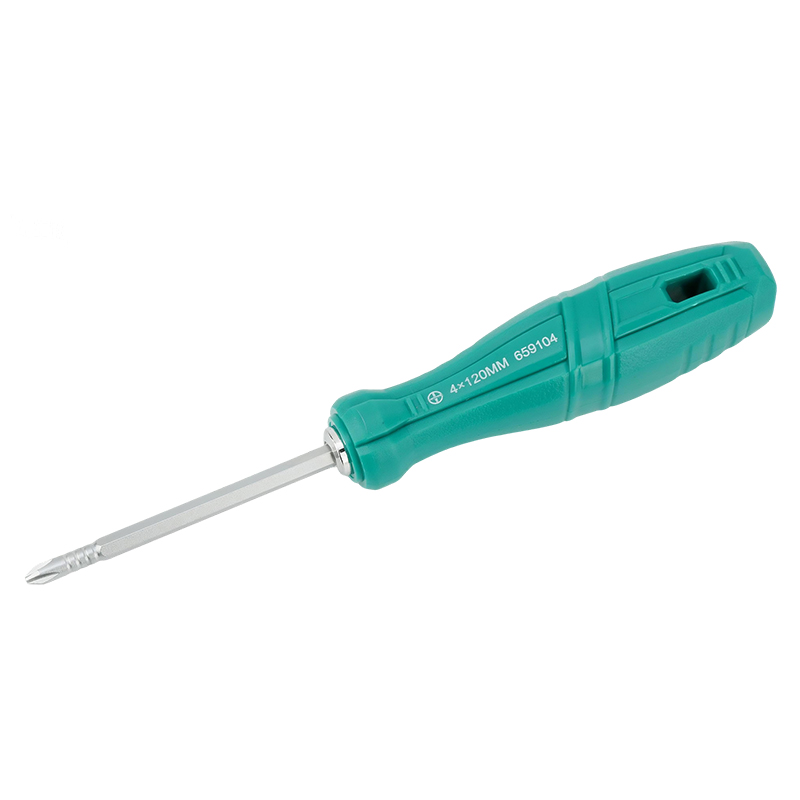
Not all multi-bit tools are capable of surviving the realities of a commercial job site. Procurement managers and professional technicians must look past the marketing and evaluate specific technical specifications to ensure the tool can actually withstand high-torque, repetitive applications.
Feature | Budget Consumer Tool | Professional Industrial Grade |
|---|---|---|
Shaft Material | Standard Carbon Steel | S2 Tool Steel or Chrome Vanadium |
Hardness Rating | HRC 45 to 50 | HRC 58 to 62 |
Handle Grip | Hard slick plastic | Thermoplastic Rubber and PP bi-material |
Tip Machining | Stamped, prone to cam-out | CNC precision milled for exact fit |
The structural integrity of the reversible shaft dictates the tool's overall lifespan. Buyers should look exclusively for shafts forged from high-grade alloys such as Chrome Vanadium steel or Shock-Resisting S2 tool steel. Chrome Vanadium offers excellent tensile strength and superior resistance to rust, making it ideal for general field repairs in varying weather conditions.
In contrast, S2 Tool Steel is renowned for its exceptional shock resistance and higher Rockwell Hardness, typically hitting HRC 58 to 62. This hardening process prevents the tips from snapping or wearing down prematurely under extreme torque. For example, a professional 6.0mm reversible blade made of S2 steel will maintain its sharp edges long after a budget alternative has rounded off.
Beyond metallurgical strength, the physical design of the handle plays a pivotal role in daily use. Field technicians often grip these tools for hours at a time, making ergonomics a critical factor for occupational health. The handle must facilitate maximum torque transfer while actively minimizing hand fatigue. High-quality models utilize Thermoplastic Rubber paired with Polypropylene cores. These bi-material components provide a comfortable, anti-slip surface that remains secure in the hand even when the user is dealing with sweat, hydraulic oil, or industrial lubricants.
For electricians and maintenance crews working anywhere near live circuits, a standard hand tool poses a lethal risk. In these unforgiving environments, the dual-purpose tool must strictly adhere to international electrical safety standards.
An insulated screwdriver is specifically designed and tested to protect the user from electrical shock. When procuring tools for electrical work, buyers must verify the presence of VDE certification or IEC 60900 compliance. These certifications indicate that the tool has undergone rigorous batch testing, including being submerged in water and subjected to ten thousand volts of alternating current. To pass and reach the market, the tool must prove it can safely protect the user up to 1000V AC and 1500V DC.
Designing an insulated reversible tool presents a unique engineering challenge. The insulation must seamlessly cover the metal shaft and integrate perfectly with the handle locking mechanism to leave absolutely no exposed metal aside from the very working tip. Manufacturers achieve this by molding thick, dielectric plastic directly onto the reversible shaft. Buyers must strictly differentiate between standard dual-purpose tools and certified insulated ones. Using a non-insulated reversible tool for live electrical repairs is incredibly dangerous.
The operational effectiveness of a dual-purpose tool ultimately comes down to the precise geometry of its tips. Poorly machined tips will inevitably damage fasteners, leading to costly project delays and potential equipment damage.
Historically, the cross-recess design was actually engineered to slip out of the screw head to prevent overtightening on automated assembly lines. However, in manual field repairs, this cam-out effect is a major frustration that aggressively strips the screw head. Professional-grade dual-purpose tools feature a precision-machined Phillips screwdriver tip cut to exact tolerances. Common sizes like PH2 bite securely into the fastener, maximizing torque transfer and giving the technician a solid, locked-in feel.
The flathead end requires equal attention to manufacturing detail. If the blade is too thick, it will not seat deeply enough into the screw slot. If it is too thin, it will bend or snap under rotational pressure. A high-quality slotted screwdriver tip is essential for turning older fasteners, gently prying open small electrical junction boxes, and securing delicate wires into terminal blocks. Ensuring the width of the slotted tip, such as a standard SL6, perfectly matches the corresponding cross-recess size on the opposite end creates a balanced, predictable utility tool.
Efficiency in field repairs is not merely about working faster. It is about optimizing your physical workflow, reducing bodily strain, and minimizing the potential for mechanical errors. The integration of a dual-purpose tool into a technician daily kit offers measurable operational advantages.
Time-motion studies in field service consistently show that the seconds spent searching for, retrieving, and swapping tools compound into significant lost labor hours over a month. Modern dual-purpose tools are engineered with rapid-change mechanisms to eliminate this drag. Imagine an electrician removing the outer cover of a control panel using one end of the shaft. Upon removing the cover, they immediately need to adjust a delicate terminal block. Instead of reaching for a new tool, they can pull the shaft, flip it, and deploy the alternative drive with one hand, maintaining total focus on the task.
The utility of this two-in-one design extends far beyond basic electrical wiring. In the HVAC industry, technicians frequently transition between securing heavy exterior condenser panels and wiring delicate low-voltage thermostats. In the automotive sector, mechanics deal with everything from rusted hose clamps to fragile interior dashboard panels. Across all these diverse applications, having both primary drive options instantly available ensures that field workers are rarely caught off guard.
For facility managers and procurement officers, purchasing hand tools at scale is an exercise in risk management and Total Cost of Ownership analysis. Equipping a fleet of technicians with substandard gear inevitably leads to increased replacement costs and compromised job site safety.
When sourcing equipment for enterprise use, procurement teams must prioritize industrial hand tools that adhere to strict international manufacturing standards, such as DIN or ISO specifications for dimensional accuracy. Requesting documentation proving that insulated tools have been individually batch-tested guarantees safety and limits corporate liability. Purchasing from established manufacturers with dedicated quality control facilities ensures consistency across large orders.
While a premium dual-purpose tool carries a higher upfront cost than a budget alternative, the long-term return on investment is substantially better. When a cheap tip fails, it not only ruins the tool but often strips the screw head, turning a simple five-minute adjustment into a costly, hour-long extraction process. Factoring in the extended lifespan and the drastic reduction in damaged fasteners makes investing in premium tools a fiscally responsible decision.
Even the highest quality hand tools require periodic maintenance to perform at their peak. A dual-purpose screwdriver is constantly subjected to harsh environments, varying temperatures, and intense friction. Implementing a basic after-care protocol ensures the tool remains safe and reliable.
The convenience of a magnetic screwdriver relies entirely on its ability to securely hold fasteners deep inside dark server racks or engine bays. Permanent magnets can lose their strength over time due to repeated physical impacts or exposure to extreme heat. If the tip begins to lose its pulling force, technicians can easily restore it using a standard magnetizer block. Passing the metal tip through the positive cavity instantly realigns the magnetic domains within the steel.
For an insulated tool, maintenance is quite literally a matter of life and safety. After completing tasks in greasy environments, the handle should be wiped down using a mild soap and water solution. Harsh industrial solvents like brake cleaner should never be used, as they can break down the rubberized components. Technicians must also conduct regular visual inspections. If any deep cuts or gouges expose the underlying metal, the tool must be immediately retired from live electrical work.
A dual-purpose screwdriver is far more than just a minor convenience. It is a vital instrument designed to streamline daily field repairs, reduce physical strain, and significantly improve overall job site safety. By consolidating the two most critical drive types into a single, rapid-change platform, technicians can work faster and smarter.
When it comes time to purchase, buyers must look past the price tag and prioritize high-grade steel metallurgy like S2 or Chrome Vanadium, ergonomic bi-material grips, strong magnetic retention, and proper VDE insulation for electrical tasks. Upgrade your professional toolkit today to protect your fasteners and your workforce. Explore reliable, industrial-grade hand tools at Hanbon Tools to find the perfect dual-purpose solution tailored precisely for your upcoming projects.
Yes, provided you select an industrial-grade model. High-quality reversible screwdrivers utilize a deep-insertion locking collar that prevents wobble and transfers torque just as effectively as a solid shank. When the shaft is forged from S2 tool steel, the durability easily matches or exceeds standard fixed-blade consumer tools.
For general maintenance, HVAC, and electrical work, a PH2 and SL6 combination on a 6.0mm shaft is the undisputed industry standard. This size tackles over eighty percent of the fasteners you will encounter on a typical job site, offering the perfect balance of torque capacity and precision.
The capability of the tool depends entirely on its metallurgy. Look for shafts manufactured from hardened alloys specifically heat-treated to withstand high torque applications without bending or shattering. Professional models use heavy-duty friction-fit detent systems built for industrial strain.
It is only safe if the specific tool is explicitly designed, tested, and certified as an insulated tool. You must verify that the tool carries a VDE certification mark and is rated for 1000V AC. Standard dual-purpose tools feature an exposed metal shaft that will conduct electricity directly to your hand if it touches a live wire.
The switching mechanism is designed for speed and simplicity. Most high-quality dual-purpose screwdrivers utilize either a quick-release locking collar or a heavy-duty friction-fit detent system. You simply grasp the exposed metal shaft, pull it firmly straight out of the handle, flip the shaft to expose the desired tip, and push it back into the handle cavity until you feel a distinct click.
In the vast majority of cases, no. The magnetic field generated by a standard hand tool is relatively weak, just strong enough to hold a small metal screw against gravity. This level of magnetism is insufficient to damage modern solid-state electronics like motherboards or flash memory drives. Extreme caution should only be exercised around highly sensitive calibration equipment.
Slipping usually occurs because the tip is the wrong size for the screw slot, or because cheap carbon steel has worn down to create rounded edges. Consumer-grade tools often feature tapered flathead tips rather than parallel-milled tips. Investing in premium tools ensures precise CNC milling that firmly grips the screw head during high-torque turning.


